
In the modern landscape of smart manufacturing and Industry 4.0, maintaining high throughput, unwavering precision, and operational safety is essential. Traditional hard-wired relay systems are no longer sufficient for complex, high-speed production environments. PLC automation systems serve as the digital brain behind modern industrial operations.
Whether controlling an automated assembly line, managing robotic material handling, or coordinating intricate conveyancing networks, a PLC-based automation system offers the intelligence, reliability, and speed required to keep industrial processes running smoothly.
Understanding PLC automation systems—including their architecture, operational mechanics, key benefits, and real-world industrial implementations—is vital for plant managers, system integrators, and industrial engineers evaluating plant modernization.
What is a PLC-Based Automation System?
A Programmable Logic Controller (PLC) is a ruggedized industrial computer designed to execute real-time control functions over continuous manufacturing processes, electromechanical machinery, and robotic devices. Unlike consumer computers, PLC automation systems are engineered to operate continuously in harsh industrial environments exposed to electromagnetic noise, temperature fluctuations, dust, vibration, and high humidity.
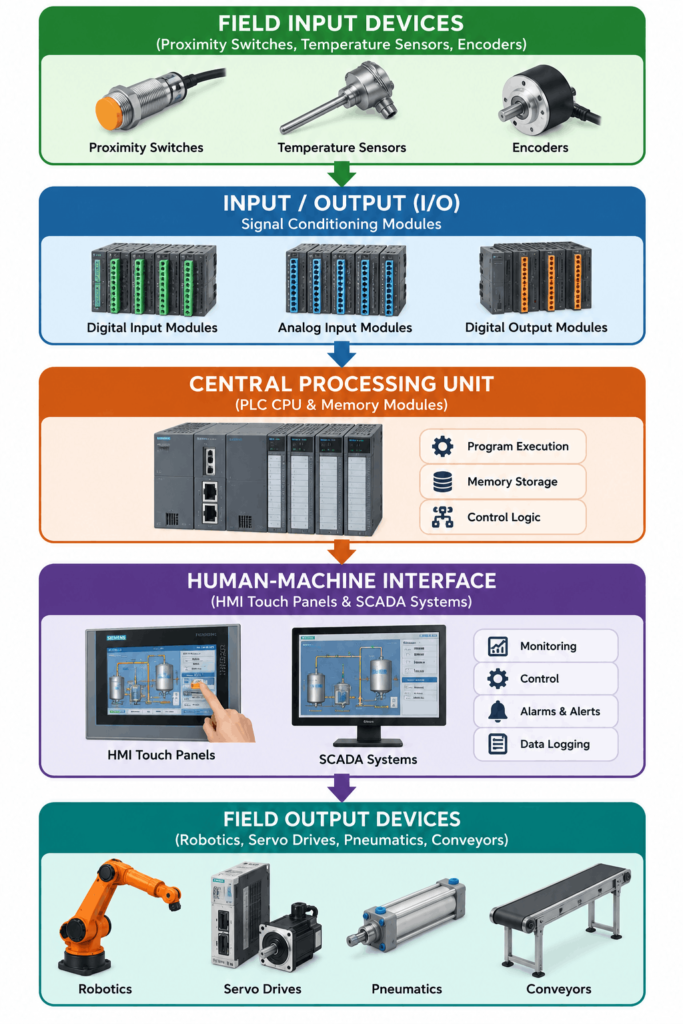
An integrated PLC-based control system gathers signals from field sensors (such as limit switches, photoelectric eyes, proximity sensors, temperature detectors, and vision controllers), processes these inputs based on pre-programmed logic, and sends output commands to industrial actuators, motor drives, pneumatic valves, solenoids, and warning indicators.
The Evolution from Hard-Wired Relays to Industrial PLCs
Before the introduction of industrial PLC automation systems, manufacturing facilities relied on massive control panels filled with physical relays, timers, counters, and intricate copper wiring. System modifications required technicians to manually disconnect and re-wire hundreds of physical relays, causing significant downtime and increasing maintenance overhead.
The invention of the PLC eliminated these bottlenecks by replacing hard-wired relay networks with programmable software logic. Today, advanced solutions like PAIR Robotics Industrial Automation Services integrate modern PLC architectures directly with 6-axis robotic arms, automated conveyancing, and custom machinery to simplify control and maximize floor space efficiency.
Architecture of a Modern PLC Automation System
To understand how a PLC-based automation system maintains total control over production, it helps to review its key hardware components and system architecture:
| Component | Primary Function | Industrial Example |
| Central Processing Unit (CPU) | Reads input states, executes control logic, and updates outputs | Microprocessor running real-time operating systems (RTOS) |
| Power Supply Unit (PSU) | Converts factory power (e.g., 230V AC) to clean DC operating voltage | Regulated 24V DC Industrial Power Module |
| Input Modules | Receives physical/digital signals from field devices | Opto-isolated Digital & Analog Input Cards |
| Output Modules | Sends control commands to field machinery actuators | Relay outputs, Transistor modules, Analog 4–20mA outputs |
| Communication Cards | Facilitates fieldbus data exchange across plant networks | PROFINET, EtherNet/IP, Modbus TCP/IP, CANopen |
| Programming Device & HMI | Allows engineers to upload programs, monitor variables, and view alarms | Touchscreen HMI Panels, Industrial PCs |
Core Hardware Components Breakdown
- Central Processing Unit (CPU): The core processor that executes the ladder logic, structured text, or function block programming stored in its internal flash memory.
- Input/Output (I/O) Architecture: I/O cards can be local (chassis-mounted) or distributed across field locations via industrial Ethernet protocols. This module translates high-voltage machine signals into low-voltage logic levels safe for CPU processing.
- Communication Bus Interfaces: Modern PLC automation systems do not operate in isolation. They communicate across industrial fieldbuses to synchronize motion cards, servo systems, machine vision systems, and enterprise supervisory control platforms (SCADA/MES). For comprehensive technical guidelines on industrial network standards, refer to official documentation from organizations such as the International Electrotechnical Commission (IEC).
How PLC-Based Automation Systems Work (Step-by-Step)
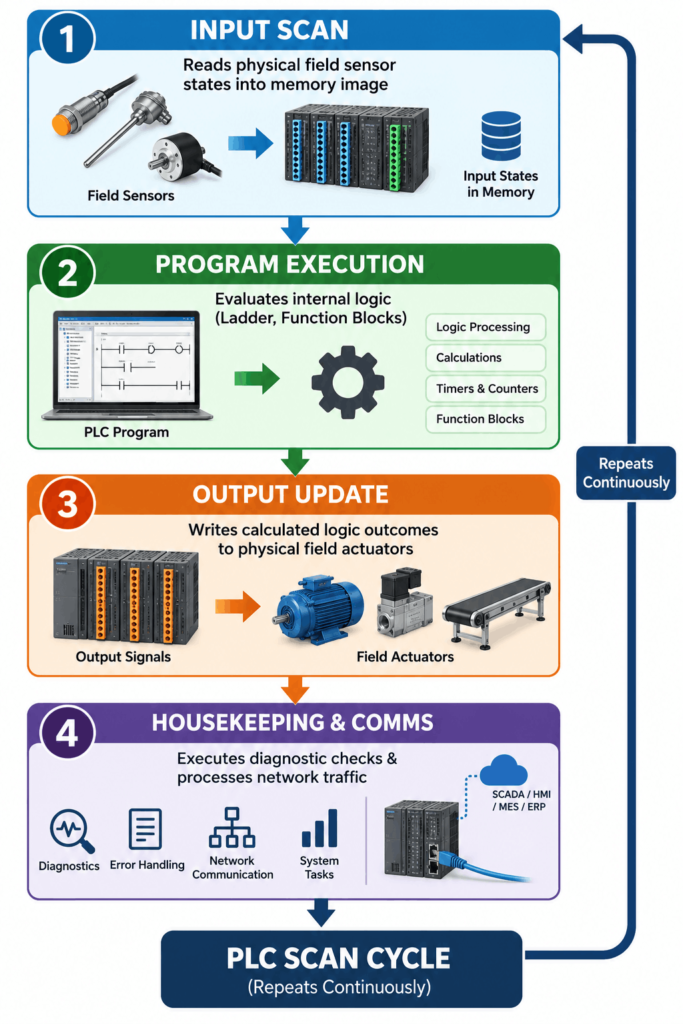
The core execution loop of any PLC automation system follows a continuous, ultra-fast Scan Cycle. This cycle executes hundreds of times per second (typically within milliseconds) to deliver real-time process monitoring and control.
The 4-Stage PLC Scan Cycle
- Input Scan Phase: The PLC checks the status of every physical input device connected to its I/O terminals and copies their signal states into a designated internal memory register (Input Image Table).
- Logic Execution Phase: The CPU reads the user-written program (such as Ladder Logic) line-by-line, utilizing the updated states from the Input Image Table to calculate conditional outputs.
- Output Scan Phase: The calculated logic outcomes are written into the Output Image Table, immediately energizing or de-energizing physical field output components (such as motor starters, pneumatic valves, and indicator lamps).
- Housekeeping & Communications Phase: The CPU completes internal self-diagnostics, checks memory integrity, updates hardware timers, and processes incoming/outgoing data packets from HMIs, robotics controllers, and supervisory networks.
Key Benefits of Implementing PLC Automation Systems
Upgrading to an advanced PLC-based control system provides measurable improvements in productivity, quality control, energy management, and workplace safety.
1. Superior Industrial Reliability and Durability
Physical relays wear down, corrode, and suffer from mechanical friction over time. Solid-state PLC automation systems eliminate moving electrical contacts within control logic, offering long operational lifespans with minimal maintenance overhead.
2. High-Speed Processing and Extreme Precision
With cycle scan times measured in milliseconds, PLC automation systems trigger high-speed operations—such as cutting, filling, positioning, and sorting—with high consistency. This level of control reduces material waste and maintains steady product quality.
3. Scalability and Operational Flexibility
When production requirements change, engineers can update the logic via software instead of re-wiring physical panels. Modular PLCs allow factories to add expander I/O cards, safety modules, and motion modules as production lines grow.
4. Real-Time Diagnostics and Minimal Downtime
Modern PLCs track operational conditions and system alarms continuously. Integrated with HMI touchscreens, PLC automation systems alert operators to exact fault locations—such as tripped circuit breakers, jammed conveyors, or overheating motors—reducing Mean Time to Repair (MTTR).
5. Seamless Robotic Integration & Smart Factory Readiness
PLCs act as the central hub for automated manufacturing cells. By integrating programmable controllers with high-performance robotic hardware—such as those featured in PAIR Robotics Turn Table CS-5 Equipment—manufacturers can coordinate automated material transfers, index rotaries, and robotic handling within a single synchronized network.
For further background on standard industrial control protocols and automation programming languages, see IEEE Xplore Digital Library.
Top Industrial Applications of PLC Automation Systems
Because of their adaptability, PLC automation systems are used across a wide range of modern manufacturing and industrial sectors.
1. Automotive Assembly and Robotic Welding
Automotive assembly lines require high precision, timing, and safety interlocking. PLC-based control systems manage line sequencing, automated conveyor movement, and safety light curtains while communicating with robotic welding cells to assemble chassis components accurately.
2. Material Handling and Automated Conveying
From warehouse sorting centers to heavy industrial plants, PLCs control conveyor speed, track package positions using vision sensors, and coordinate automated transfer turn tables to guide workpieces through complex routing paths.
3. Food, Beverage, and Packaging Operations
High-speed bottling and packaging lines depend on PLC automation systems to manage liquid filling, capping, labeling, and palletizing. The PLC synchronizes multiple encoder signals to apply labels accurately on fast-moving conveyors.
4. Pharmaceuticals and Batch Process Control
In cleanroom environments, PLCs maintain strict climate conditions, control automated chemical batching, manage sterilization routines, and collect regulatory audit data to support compliance.
Selecting the Right PLC Automation System for Your Operation
Selecting an effective PLC automation system requires careful evaluation of your current operational parameters and future expansion plans:
- I/O Capacity Requirements: Calculate the number of digital and analog inputs/outputs your process requires today, and add a 20–30% buffer for future expansions.
- Execution Speed & Processing Power: Fast processes, like multi-axis robotic tracking or high-speed motion control, require high-speed processors with fast execution times.
- Communication Protocols: Ensure the chosen controller supports your factory’s existing fieldbus infrastructure (e.g., PROFINET, EtherNet/IP, Modbus, or CANopen).
- Environmental Durability: Select IP-rated enclosures, conformal-coated circuit boards, and vibration-resistant racks if the equipment operates near high heat, washdown zones, or heavy machinery.
- Turnkey System Integration: Hardware choice is only part of the solution; expert installation, clean wiring layout, ladder logic programming, and system testing determine long-term operational success.
Transform Your Production Line with PAIR Robotics
Looking to modernize your manufacturing facilities, eliminate unexpected downtime, or integrate advanced robotic systems with custom PLC control networks? PAIR Robotics delivers end-to-end industrial control solutions tailored to your production requirements.
From system design and control panel fabrication to custom software programming, robotic cell setup, and site commissioning, PAIR Robotics helps manufacturers boost efficiency and product quality. Explore our full range of solutions on the PAIR Robotics Official Website to see how custom automation can support your operational goals.
Ready to optimize your manufacturing processes with intelligent PLC automation systems? Contact the PAIR Robotics Engineering Team today to schedule a consultation and custom technical audit for your facility.
Frequently Asked Questions (Q&A)
Q1: What is the primary difference between a PLC and a standard industrial PC (IPC)?
A PLC is built exclusively for real-time control applications with a dedicated, deterministic operating system designed for ultra-fast input/output processing. An Industrial PC runs general-purpose operating systems (like Windows or Linux) to perform complex computing, data visualization, and database management alongside control logic.
Q2: What programming languages are commonly used in PLC automation systems?
According to the global IEC 61131-3 standard, PLCs support five primary programming languages:
- Ladder Diagram (LD) – The most widely used visual language, modeled after relay logic.
- Function Block Diagram (FBD) – Visual blocks ideal for complex signal-processing logic.
- Structured Text (ST) – A high-level, text-based language similar to Pascal or C.
- Instruction List (IL) – A low-level, assembly-like syntax.
- Sequential Function Chart (SFC) – A flowchart-style language ideal for step-based sequential operations.
Q3: How do PLC automation systems communicate with industrial robots?
PLCs communicate with robotic controllers through high-speed industrial Ethernet protocols (such as PROFINET or EtherNet/IP) or hardwired digital I/O lines. The PLC serves as the primary system controller, managing line interlocks, safety systems, and cycle triggers, while directing the robot controller to execute motion paths.
Q4: Can a PLC-based control system be expanded as factory requirements grow?
Yes. Modern modular PLC automation systems allow system integrators to add expansion racks, additional digital/analog I/O cards, specialized motion control modules, and communication gateways without replacing the main CPU or rewiring the core control panel.