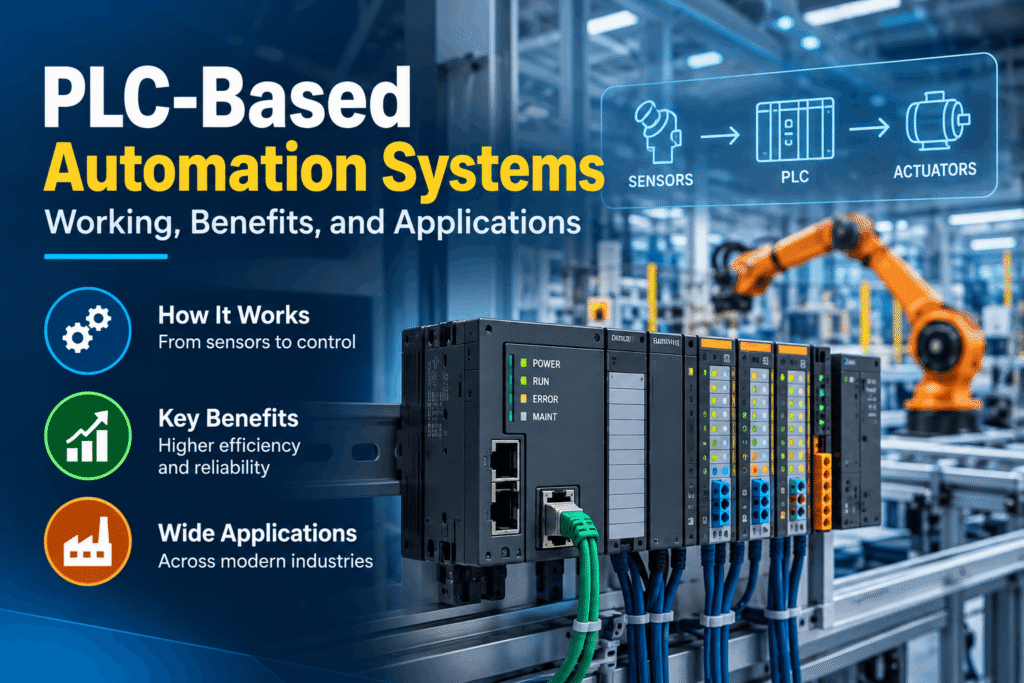
Manufacturing facility managers face relentless pressure to boost production throughput, maintain strict tolerances, and reduce operating costs. Modern machine shops cannot rely on manual loading and unloading routines without sacrificing overall equipment effectiveness (OEE). Investing in factory automation is the single most effective way to eliminate spindle downtime and maintain consistency across shifts.
However, selecting an automated cell is a strategic capital expenditure. If you select an ill-fitting machine tending setup, you risk integration delays, unexpected bottlenecks, and extended payback periods. Learning how to choose the right CNC automation system for your manufacturing plant ensures that your capital investment delivers maximum operational efficiency and high return on investment (ROI).
1. Evaluate Your Plant’s Existing Production Profile
Before browsing hardware options or requesting vendor quotes, evaluate your current manufacturing workflow. The nature of your parts dictates the structural design of your ideal CNC machine tending automation system.
High-Volume vs. High-Mix Low-Volume (HMLV) Production
- High-Volume, Low-Variety (HVLV): If your plant runs thousands of identical automotive components per week, speed and cycle-time optimization take priority. In this environment, fixed automation setups, such as dedicated 3-axis overhead gantry systems, deliver rapid load-unload cycles.
- High-Mix, Low-Volume (HMLV): If your shop processes diverse job lots with frequent engineering changes, prioritize setup flexibility. Articulated industrial robots or collaborative robots (cobots) equipped with quick-change grippers allow operators to switch part programs with minimal downtime.
Part Geometry, Weight, and Material Characteristics
Assess the maximum payload requirements across your product lines. Payload includes the raw part weight plus the weight of the end-of-arm tooling (EOAT) and dual-gripper assemblies. Heavy castings require rigid floor-mounted six-axis robotic arms. Delicate turned components require precise force-torque sensing to prevent surface damage during chucking.
2. Understand Key Types of CNC Automation Systems
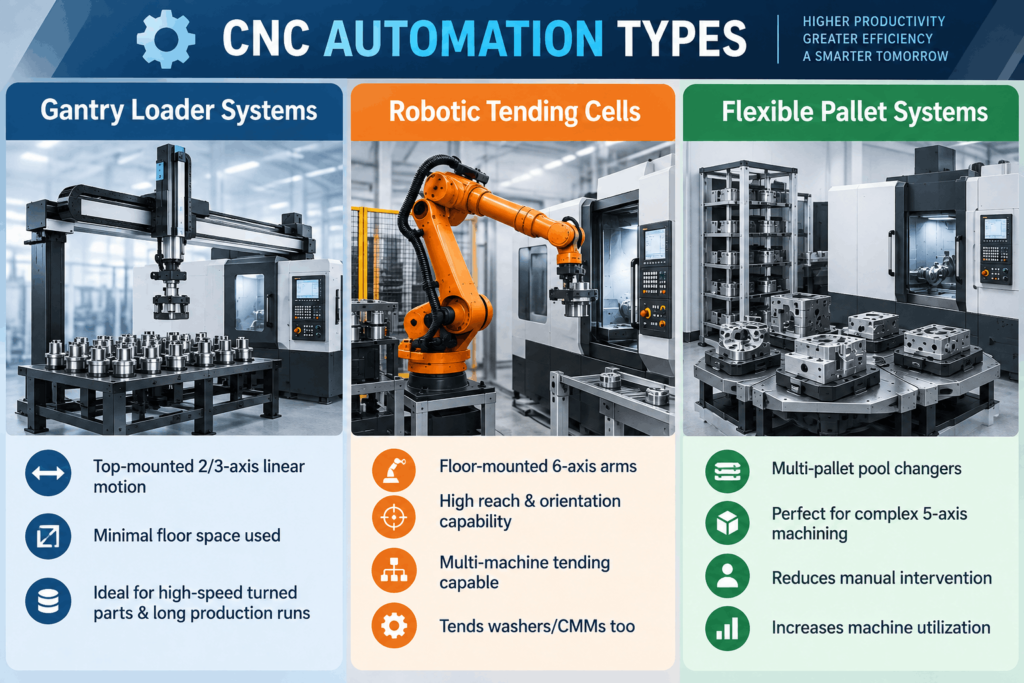
CNC machine tending automation is not a one-size-fits-all product. Understanding the core structural categories helps you narrow down options based on floor space, machine accessibility, and cycle times.
Gantry Loader Systems
Top-mounted gantry loaders move linearly along horizontal beams above the machine tools. Because they load parts through the top door or front panel from above, they leave the front floor area free for operator access. They are exceptional for high-speed turned parts and high-volume shafts.
Floor-Mounted 6-Axis Robotic Tending Cells
A floor-mounted industrial robot mounted on a pedestal or linear track offers unmatched geometric dexterity. A single 6-axis robot can service multiple CNC lathes or vertical machining centers (VMCs), while simultaneously tending auxiliary operations like part washing, air blowing, deburring, and vision-based inspection stations.
Flexible Pallet Systems and Mobile Automation
For complex 5-axis machining centers, pallet automation systems swap entire fixtures rather than individual raw workpieces. Autonomous Mobile Robots (AMRs) paired with cobots represent the cutting edge of material handling, transporting raw materials from raw stock inventory directly to machine beds without human intervention.
3. Map Floor Space and Machine Access Constraints
Installing an automated cell changes your plant’s layout, material flow, and safety parameters. Integrating new hardware without a proper spatial audit often leads to operational friction.
Footprint vs. Reach
Calculate the total workspace footprint, including safety perimeter fencing, light curtains, part storage racks, and conveyor systems. Ensure the robot’s working envelope reaches chucks and vices without risking mechanical collisions with machine enclosures or tool changers.
Maintaining Operator Accessibility
Automation should complement your machinists, not block them. Choose a setup that allows manual intervention when needed. Swing-arm mounts, sliding robot bases, or top-entry overhead gantries allow operators to walk up to the CNC control panel for manual tool setups, offset adjustments, or first-article quality inspections without dismantling safety barriers.
4. Key Technical Criteria Checklist
When evaluating vendor proposals, use this criteria checklist to confirm your chosen CNC automation system meets technical performance expectations:
| Technical Criteria | Considerations & Target Metrics | Operational Benefit |
| Payload Capacity | Raw part weight + Gripper assembly weight + 25% safety margin | Prevents mechanical wear and joint overload |
| System Precision | Positional repeatability within ±0.02 mm to ±0.05 mm | Guarantees accurate part seating inside chucks/fixtures |
| EOAT Gripper Tech | Mechanical, pneumatic, vacuum, or servo-driven dual-grippers | Cuts chip-to-chip loading time by swapping parts in one entry |
| PLC & Controls Integration | Seamless bus communication (Profinet, EtherNet/IP, Modbus) | Syncs robot routines with CNC door actuation and cycle signals |
| Part Feeding Systems | Infeed/outfeed conveyors, rotary indexing tables, or bowl feeders | Extends unattended lights-out manufacturing windows |
5. Calculate Real ROI and TCO (Total Cost of Ownership)
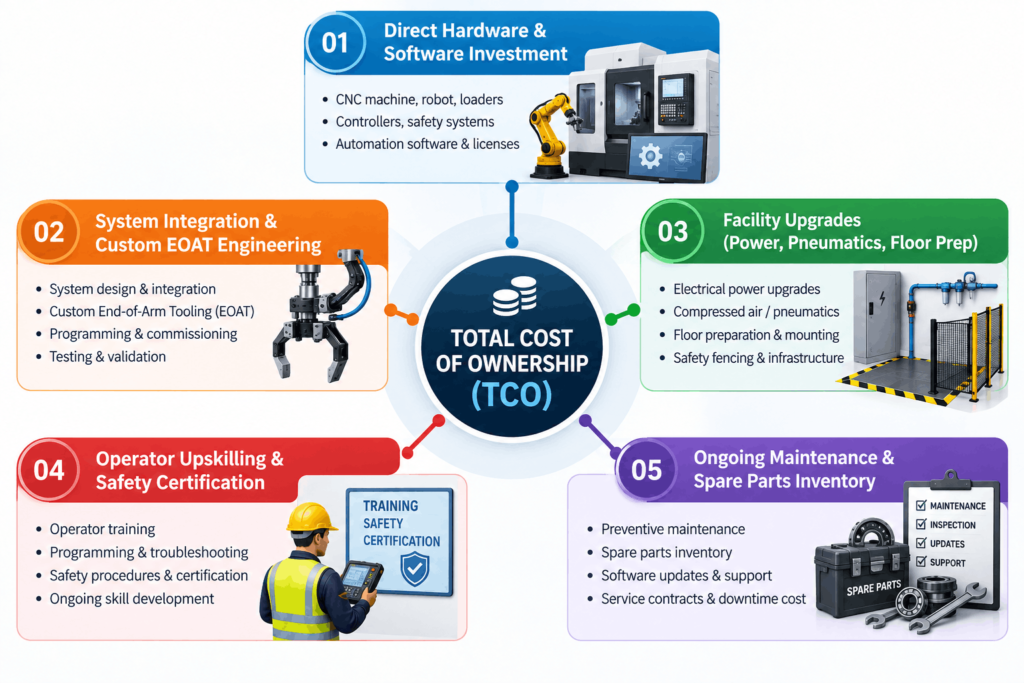
Evaluating the financial viability of an automated machine tending investment requires analyzing more than just the initial equipment invoice.
Upfront Capital vs. Long-Term Productivity
Calculate payback schedules by factoring in labor reallocation, scrap reduction, and additional machine hours. Machine tending automation routinely boosts spindle utilization from 50% up to 85–90% by running continuous unattended night shifts—commonly known as lights-out manufacturing.
To establish an accurate benchmark for machine availability and productivity gains, review NIST’s Advanced Manufacturing Guidelines for standard calculations on operational efficiency and factory productivity metrics.
Factor in Hidden Costs
When calculating your Total Cost of Ownership (TCO), remember to include:
- Custom End-of-Arm Tooling (EOAT) design and fabrication
- Software licensing and PLC programming hours
- Plant preparation (floor anchoring, clean compressed air lines, power drops)
- Safety enclosure compliance and risk assessment audits
- Operator training and preventive maintenance programs
6. Evaluate System Integration and Control Compatibility
A industrial robot arm is only as effective as its integration with your CNC machine controls. The system must communicate seamlessly to avoid cycle crashes and false alarm halts.
Software and PLC Interface Simplicity
Modern factory automation relies on intuitive, user-friendly human-machine interfaces (HMIs). Operators should be able to configure new part routines, adjust pickup positions, and clear minor system faults without calling a specialized robotics programmer every time a job changes. Standardized communication protocols simplify integration across mixed-brand machine shops.
Safety Interlocking Protocols
The system design must incorporate fail-safe hardware interlocks. The robot should never enter the CNC working envelope until the machine tool confirms the spindle has completely stopped, the coolant blast is off, and the fixture clamps are open. Standard safety standards, such as those defined by the International Organization for Standardization (ISO 10218), provide global guidelines for industrial robot safety and collaborative operation.
7. Select the Right Automation Partner
Hardware specifications are only part of the equation; the engineering expertise of your system integrator determines long-term success. A capable partner evaluates your production line holistically, engineers tailored fixtures, and provides long-term technical support.
When selecting an integration partner, ensure they possess:
- Proven Turnkey Experience: A track record of successfully deployed machine tending cells across diverse industrial sectors.
- In-House Engineering Capabilities: Complete design, manufacturing, and software programming teams under one roof.
- Comprehensive After-Sales Support: Rapid on-site assistance, spare parts availability, and regular maintenance programs.
Transform Your Factory Floor with PAIR Robotics
At PAIR Robotics (Precisely Automated Industrial Robots Pvt. Ltd.), we specialize in designing and deploying end-to-end industrial automation solutions tailored to your plant’s exact operational requirements.
Whether you need a high-speed gantry loader, a multi-machine robotic tending cell, or a custom Special Purpose Machine (SPM), our experienced engineering team delivers reliable, scalable systems that lower cycle times and maximize productivity.
From concept design and PLC software integration to installation, commissioning, and operator training, we walk with you through every step of your digital transformation journey.
- Custom Machine Tending Cells tailored to your CNC machine tools.
- Turnkey Robotic Integration with integrated vision and inspection capabilities.
- Robust PLC & Software Architecture built for lights-out manufacturing performance.
Ready to eliminate spindle downtime and scale your manufacturing throughput? Contact PAIR Robotics Today to discuss your project with our automation specialists.
Frequently Asked Questions (Q&A)
Q1: What is the main benefit of installing a CNC automation system?
The primary benefit is a significant increase in spindle uptime and overall equipment effectiveness (OEE). CNC automation eliminates manual loading delays, reduces human error, maintains consistent cycle times, and allows your plant to run unattended or “lights-out” shifts safely.
Q2: Can older, legacy CNC machines be automated?
Yes. Most legacy CNC machine tools can be retrofitted with automated machine tending systems. Integrators install external interface modules to sync machine door actuation, automatic vise clamping, and cycle start/stop signals with the robotic controller.
Q3: How do I choose between a cobot and an industrial robot for CNC tending?
Choose a collaborative robot (cobot) if you have limited floor space, low-to-medium payload requirements, and need quick setup changes for high-mix job runs. Choose a traditional industrial robot if you require heavy payload capacities, high speed, or harsh washdown environment protection.
Q4: What is the average payback period for a CNC machine tending setup?
Most well-engineered CNC automation projects achieve full capital payback within 12 to 24 months. Payback timelines depend on labor savings, scrap reduction, and the total additional operational hours gained by running night and weekend shifts.
Q5: How does vision guidance improve CNC automation cells?
Integrated 2D or 3D vision systems allow robots to identify, pick, and orient randomly placed raw parts from conveyors or bins. This eliminates the need for expensive precision trays or manual part positioning by operators.